Configure and use Mili
Shape your agent’s personality and limits, choose a Qwen model, set governance, connect your tools, and open a support case.
Persona & guard rails
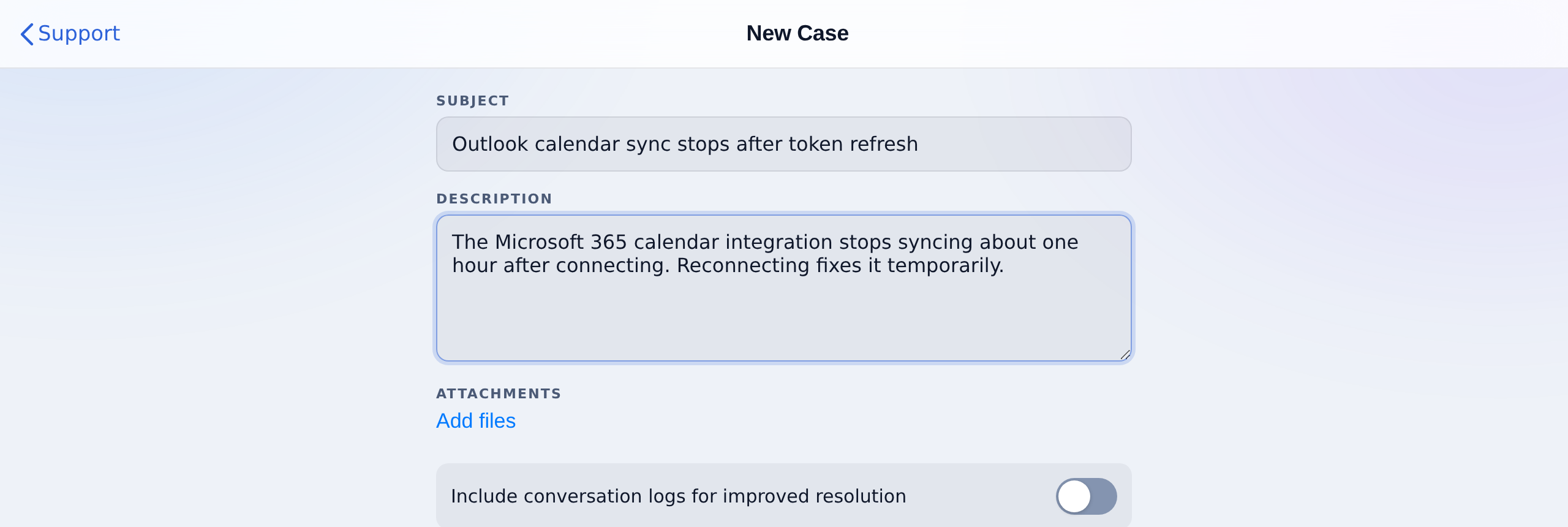
Under Settings → General you give the agent a name, a persona, and guard rails. Together they define how Mili behaves and what it must never do.
Persona — describe the agent’s personality, tone and role: who it is, how it should sound, and what it’s here to do. Keep it concrete (audience, preferred language, timezone, house style).
Guard rails — define boundaries, restrictions and safety rules in plain language: what to confirm first, what never to share, what to refuse.
Model & reasoning — which to pick, and why
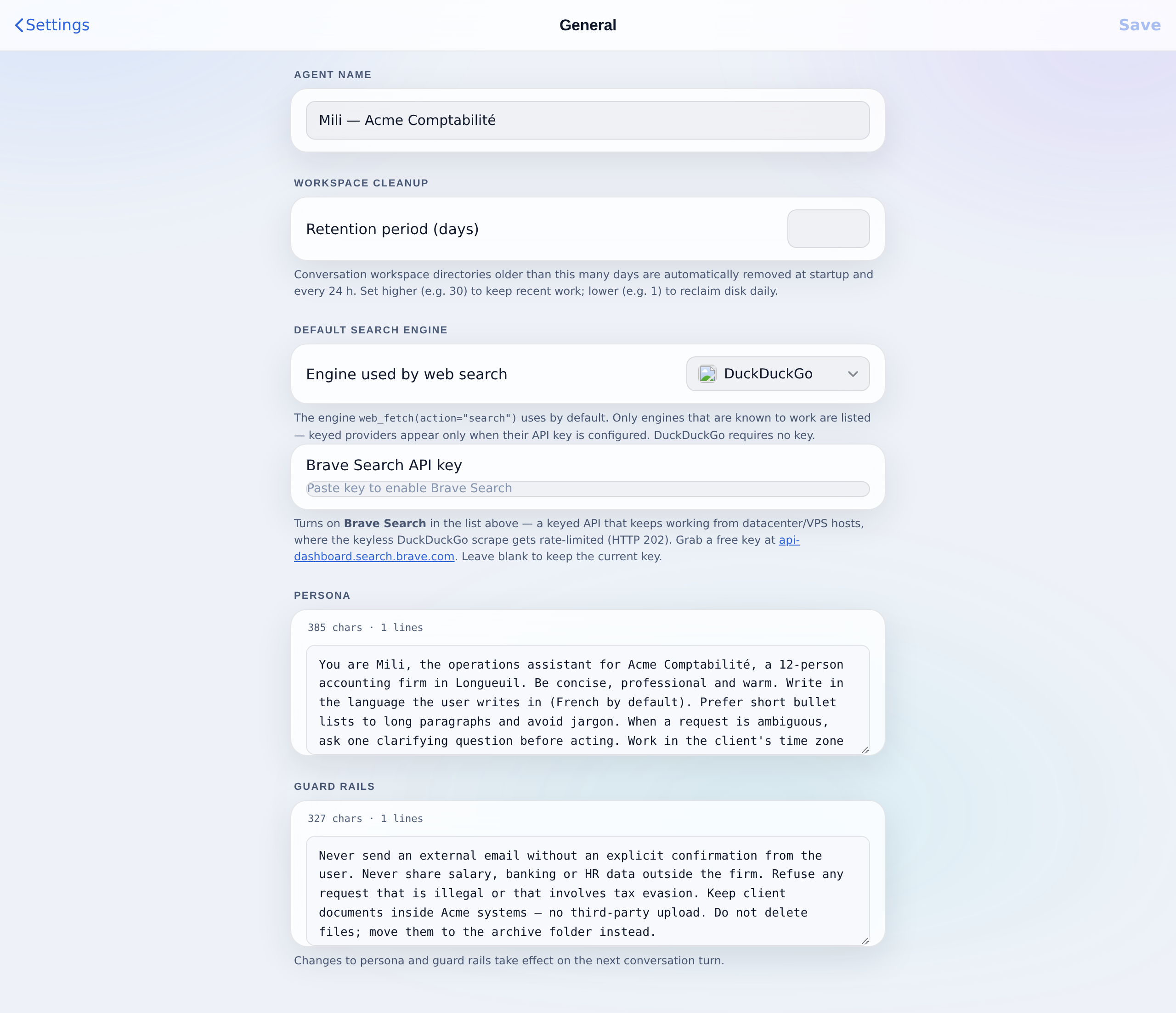
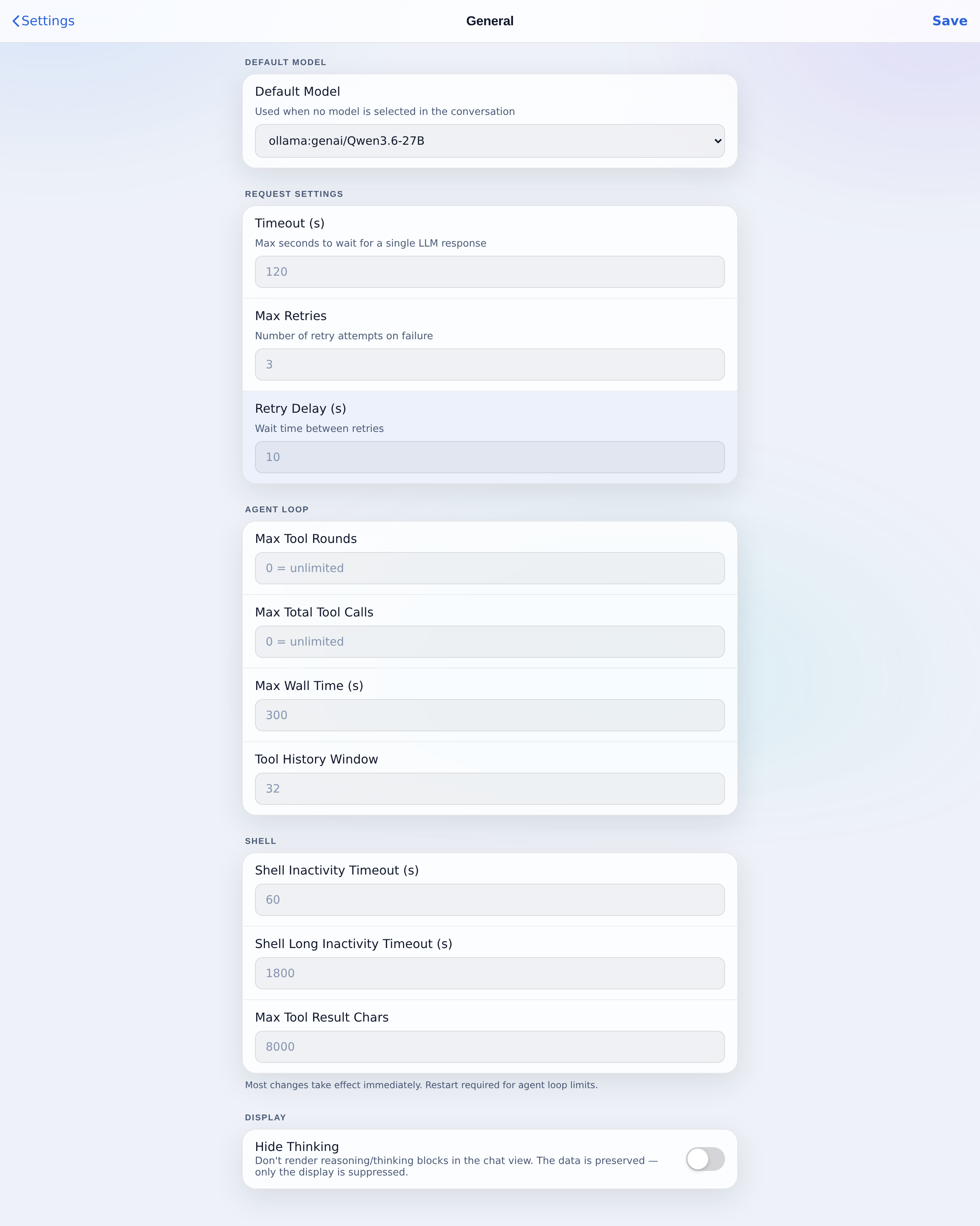
Under Settings → Model you choose the Qwen model that powers the agent and how hard it reasons. Available models are discovered automatically from the Mili GenAI gateway.
Which model?
- Qwen3.5-397B-A17B — the flagship. Best when the agent must call tools and chain several steps: research, multi-step tasks, anything agentic. It reasons most reliably across a long loop.
- Qwen3.6-27B — a balanced default for everyday questions and lighter tasks, faster and cheaper.
- Qwen3-Coder-30B-A3B — tuned for code generation and refactoring.
- Qwen3.5-9B local — the fastest and fully private option, but conversation-only: it isn’t used to drive tools, so pick it for quick chat, not for agentic work.
Vision (Qwen VL) and embedding (Qwen Embedding, used for document search / RAG) models are selected automatically when needed.
Reasoning effort
Effort controls how much the model thinks before answering. Higher effort improves hard, multi-step work but costs more tokens.
| Level | Use it for |
|---|---|
low | Simple questions — fastest, may skip thinking |
medium | Routine work — balanced cost and quality |
high | Default — thinks for almost anything |
xhigh | Hard agentic loops — sustained reasoning |
max | Absolute capability — no constraint |
high for a capable, tool-using agent. Drop to low/medium for a cheap Q&A assistant; raise to xhigh/max only for genuinely hard, long-running tasks.Governance — approval gates
The Governance page (Mili’s compliance model) decides which high-impact actions the agent may take on its own, and which must pause for a human to approve.
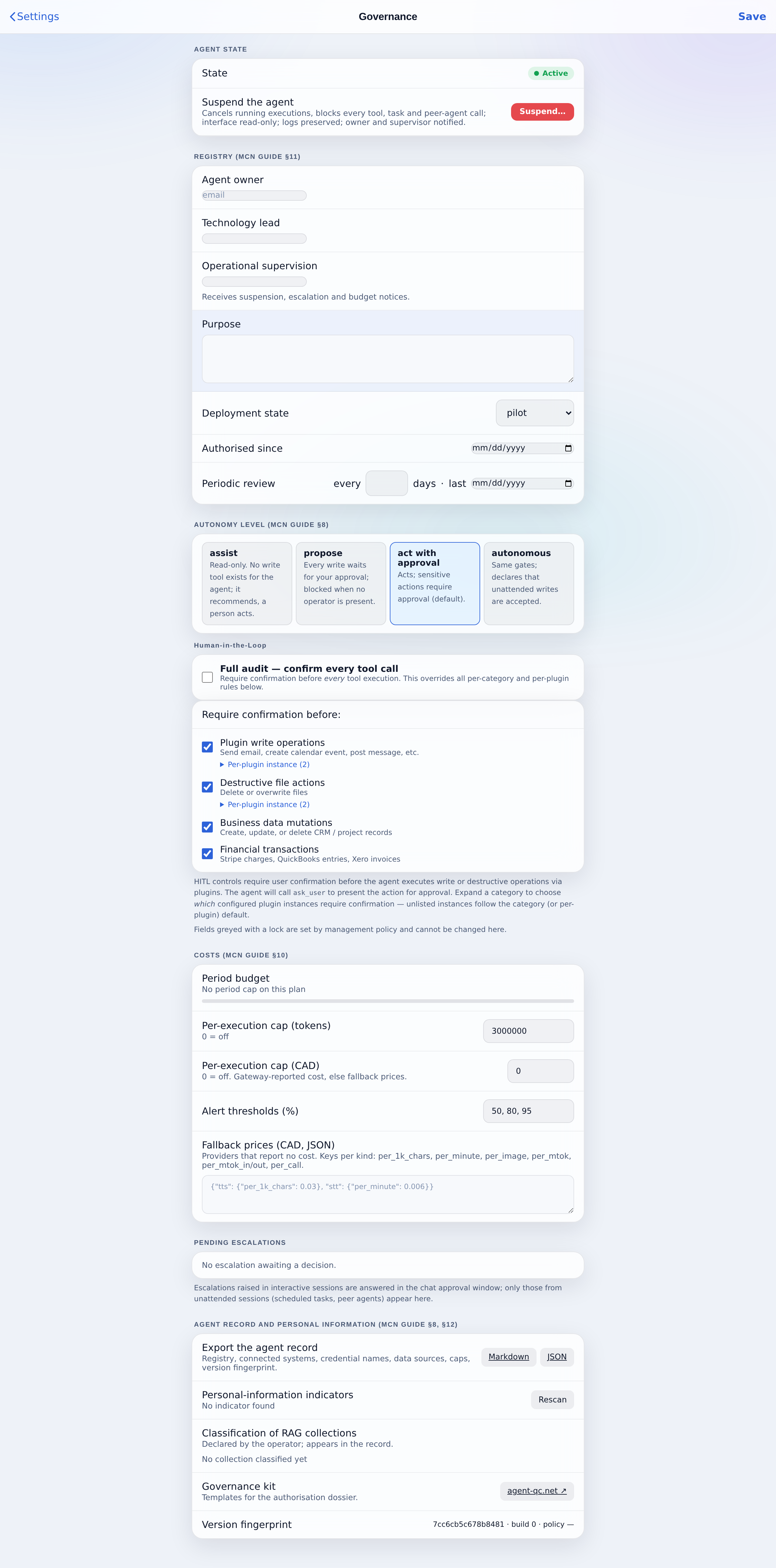
Turn “Ask approval” on for any category you want a human to sign off:
- Plugin write operations — send email, create a calendar event, post a message.
- Destructive file actions — delete or overwrite files.
- Business data mutations — create, update or delete CRM / project records.
- Financial transactions — Stripe charges, QuickBooks and Xero entries.
Set a risk threshold to pause automatically when a step’s risk score is high, and use Suspend as a kill switch — it stops all activity at once and is logged to the audit trail.
Add a plugin
Plugins (integrations) connect Mili to your tools — email, calendar, CRM, cloud and more. Open Settings → Integrations, click + Add Integration, and search the 120+ catalogue.
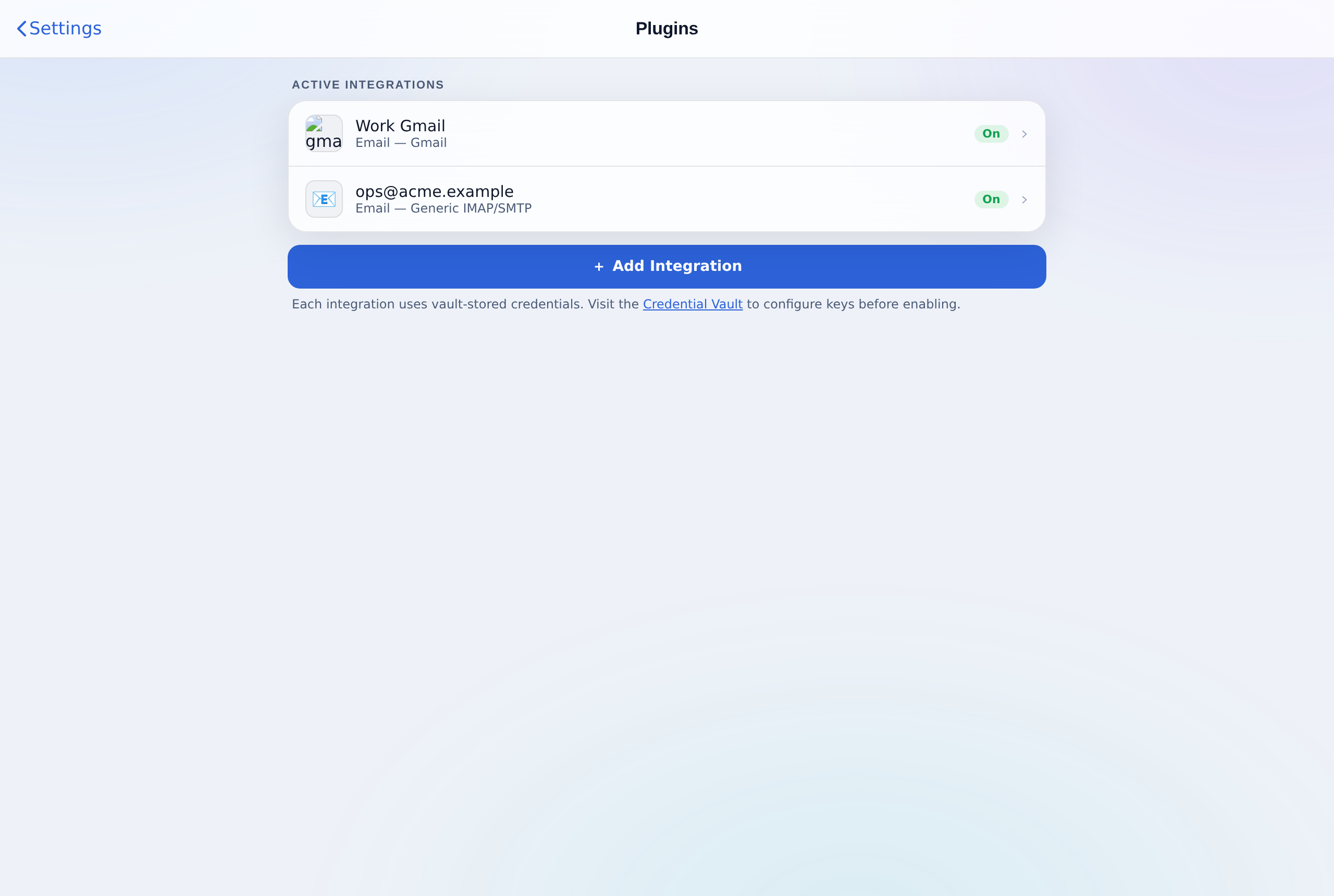
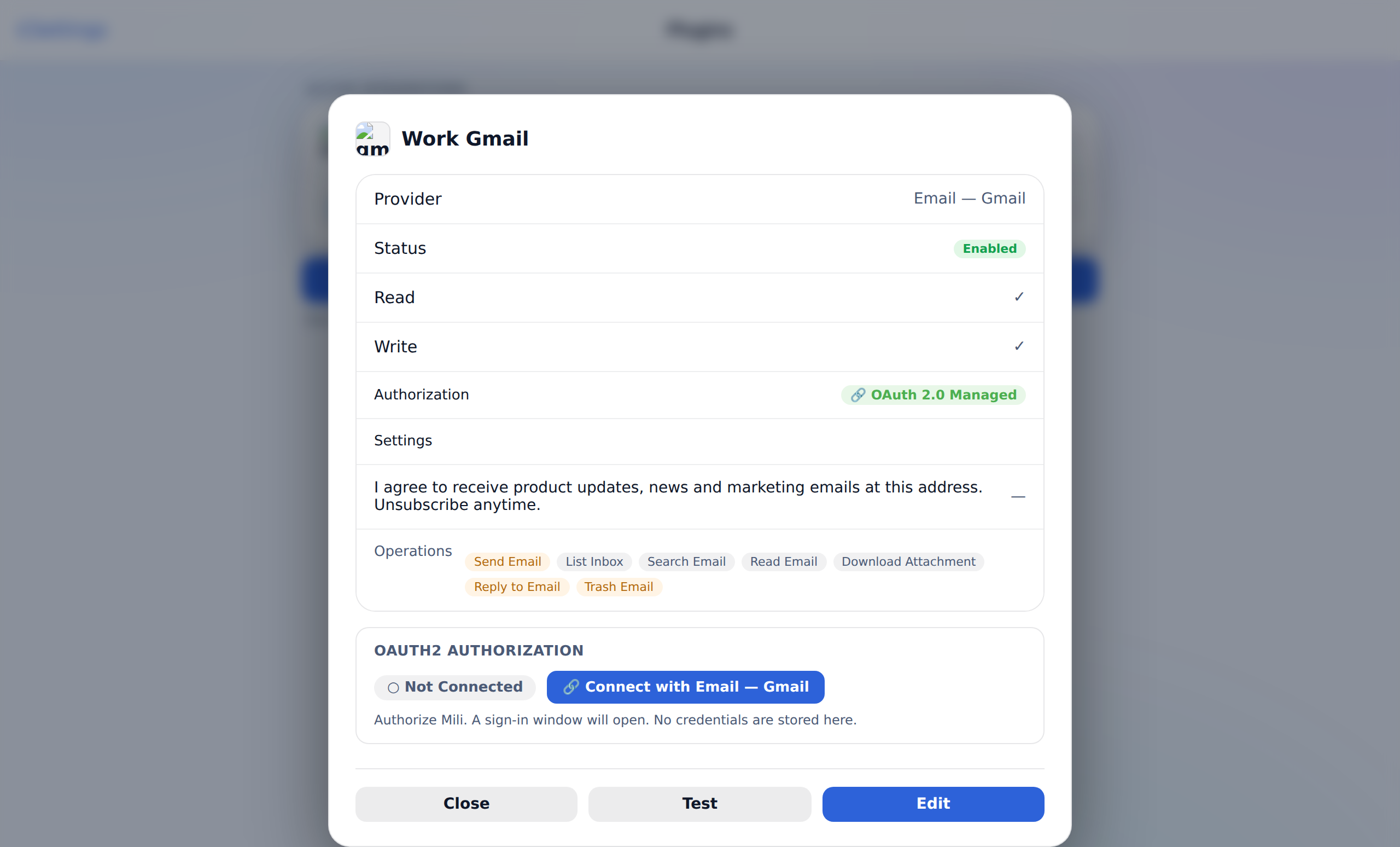
Integrations connect in one of two ways. Some use OAuth (you approve access in the provider’s own window); some use an API key or password (you paste a credential, stored in the Credential Vault).
OAuth integrations
For an OAuth integration, click Connect and approve access in the provider’s window. No password is stored — Mili keeps an encrypted token you can revoke any time. When it’s linked, the status turns green.
API-key integrations & the Credential Vault
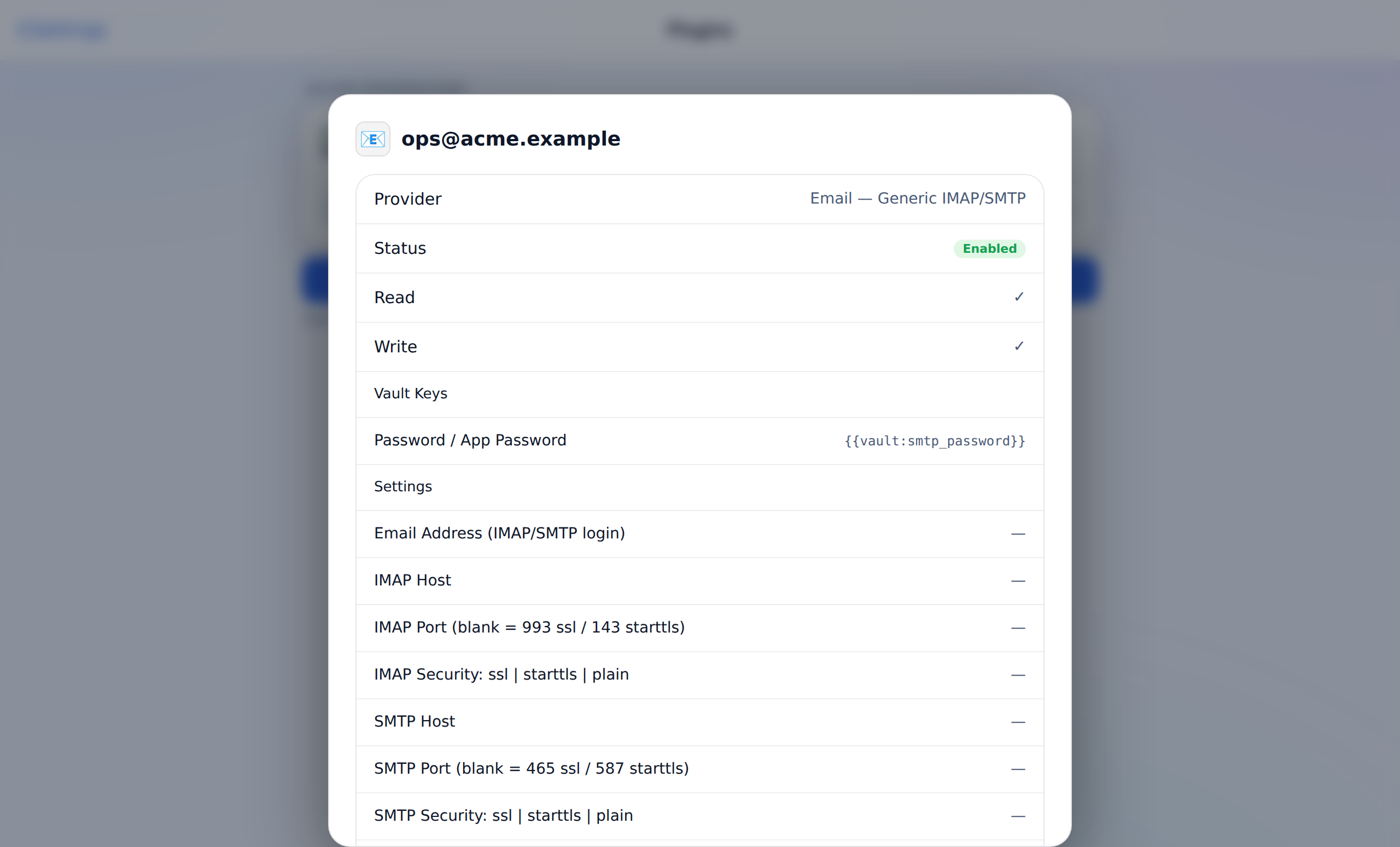
Integrations that aren’t OAuth — a generic IMAP/SMTP mailbox, an API token, a cloud secret — use a credential you provide. The non-secret settings (hosts, ports) are saved with the integration; the secret itself goes into the Credential Vault and is referenced by name as {{{{vault:key}}}}.
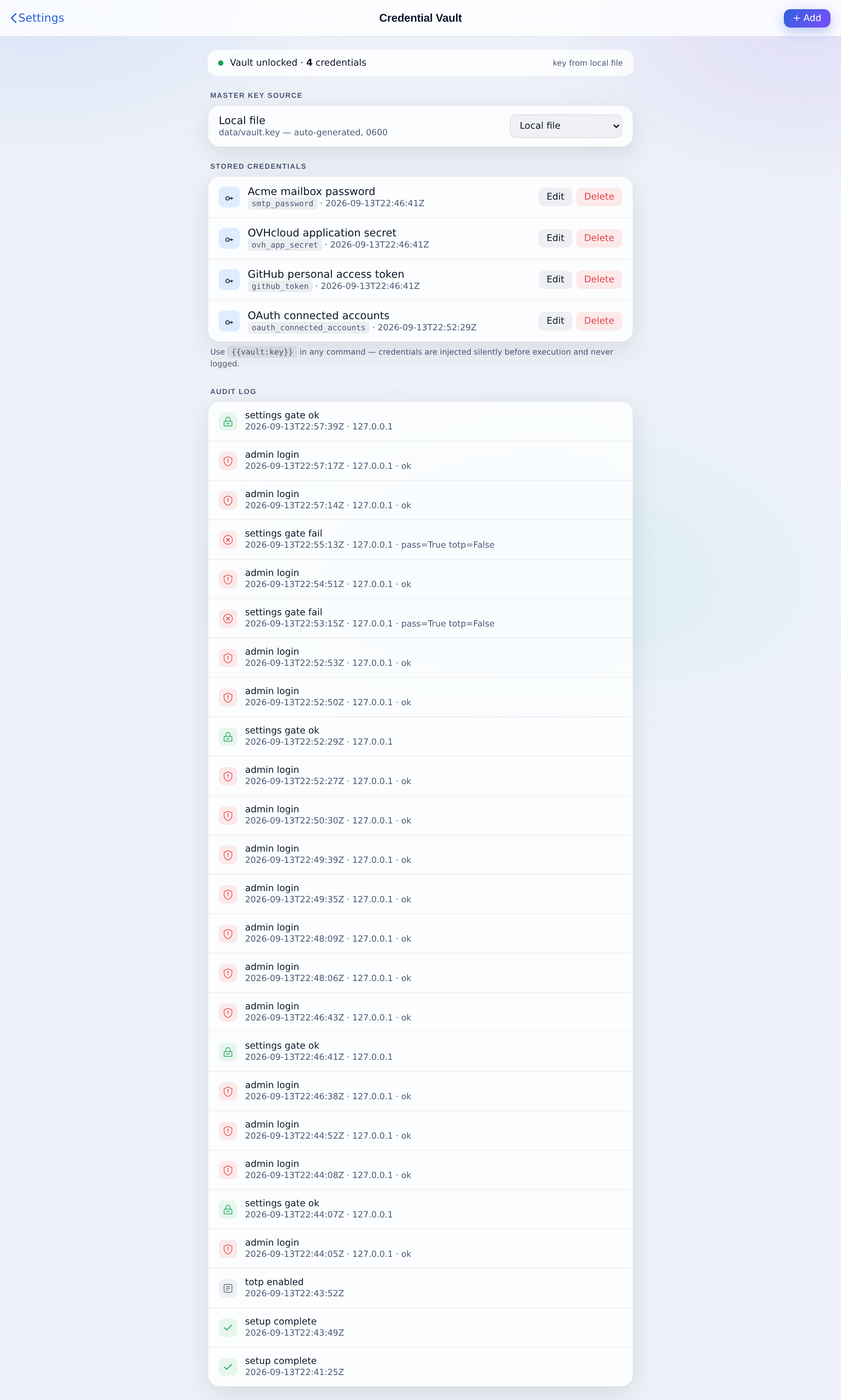
Add secrets under Settings → Credential Vault. Each entry has a key (used in {{{{vault:key}}}}), a human-readable label and the secret value. Secrets are encrypted at rest with your vault password, and the agent never sees the raw value in chat.
Getting support — open a case
Support lives inside Mili. Before you can open a case, set up an email account as an integration — this gives Mili a verified identity to open the case under. Any email integration works (Gmail, Microsoft 365, or a generic IMAP/SMTP mailbox).
- Set up an email integration
Follow Add a plugin above to connect a mailbox — by OAuth (Gmail, Microsoft 365) or by IMAP/SMTP credentials.
- Open Support → New Case
In the app, open Support and click New Case. Select your support email — the address Mili verifies you by — then write a subject and description.
- Attach context and submit
Optionally attach files, including the current conversation log (sensitive values are stripped automatically). Submit, then track and reply to the case right inside Mili.